Why your car (and your flat) still rattles and feels cold — and how to fix it for the price of lunch
ISOLMAT M closed-cell rubber insulation foam tackles body drone, wind noise and cold sheet metal in cars and homes — under 0.1% water absorption and thermal conductivity from 0.034 W/mK.
You get in the car, shut the door, and instead of a quiet “clunk” you hear a tinny rattle, like closing a sardine can. On the motorway, wind roars around the mirrors so loudly you have to crank the radio. And at home? You hear every step your upstairs neighbour takes through the ceiling, as if they were walking through your own living room.
Most people shrug and say “that’s just how it is” and live with it. I’d like to convince you that you don’t have to.
The answer is called ISOLMAT M closed-cell rubber insulation foam, and it costs less than you’d think. Let’s look at why it works and exactly where it will save your nerves.
Why ordinary foam isn’t enough
Here’s something most insulation sellers won’t tell you: not all foam is the same. There are two completely different worlds.
Open-cell foam (the classic acoustic PU foam you know from recording studios) works like a sponge — the cells are interconnected, so air and moisture pass through it freely. Great for absorbing echo in a room. A disaster if it comes into contact with water or damp air, because it soaks up moisture like a sponge and eventually starts to mould.
Closed-cell foam, like ISOLMAT M, is the exact opposite. Every air bubble is hermetically sealed inside its own wall of foamed synthetic rubber. Neither water nor water vapour can get through it — water absorption is under 0.1%. That also makes it a vapour barrier, preventing condensation on cold sheet metal (exactly where rust and mould form).
That property is precisely why ISOLMAT M works where ordinary foam fails: car doors, wheel arches, bathrooms, air-conditioning ducts, washing machines.
Heat escaping through the metal
Try putting your hand on a car’s metal door in winter for a moment. Cold, right? That’s because metal is an excellent heat conductor, and without a barrier it literally pulls the heat straight out of the cabin.
ISOLMAT M has a thermal conductivity of just 0.034 W/mK at -30 °C (and a still-excellent 0.036 W/mK at 0 °C). For comparison, that’s a figure you’d expect from quality building insulation, not a thin foam sheet on metal. At 25 mm thickness, the foam weighs only 1.35 kg per square metre, so you’re adding insulation, not dead weight.
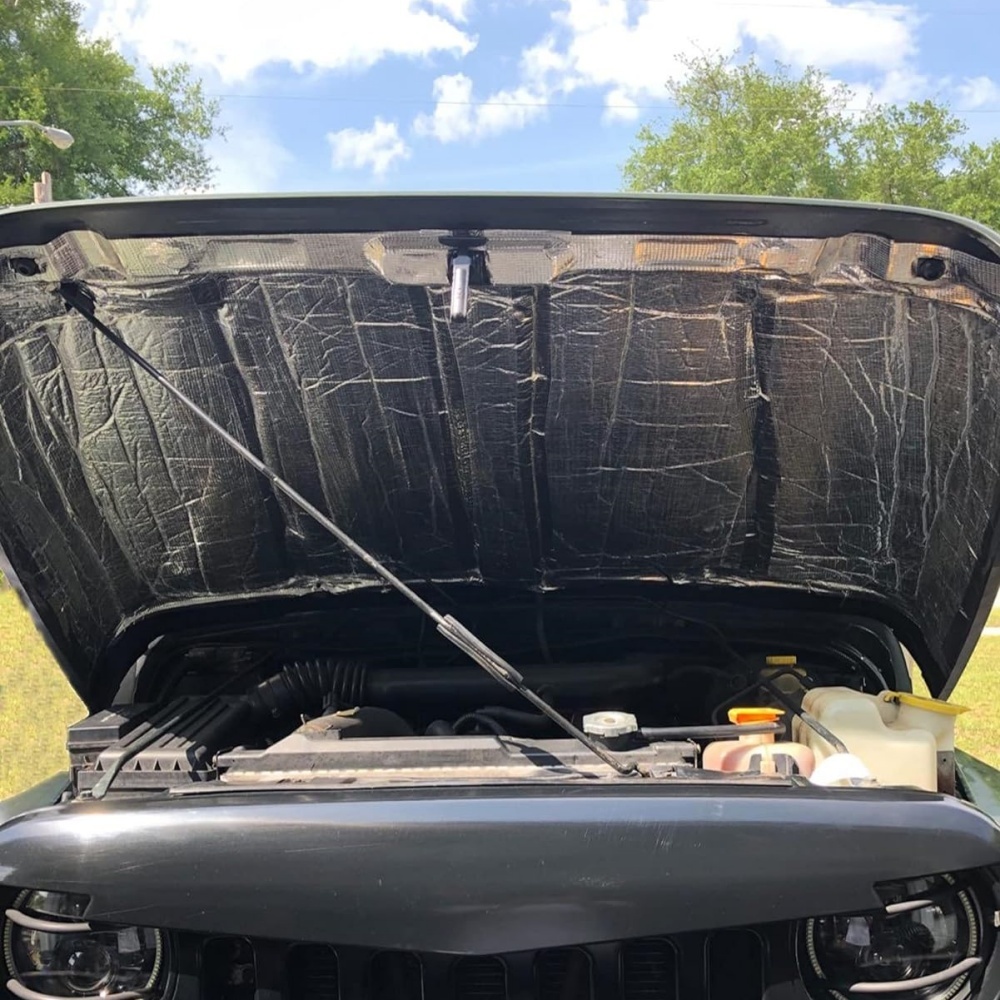
Practical tip: if you’re insulating a car for both winter and summer (roof, doors, bonnet), the foam works both ways — in winter it keeps heat in, in summer it stops hot air from sun-baked metal heating up the interior.
Why one layer isn’t enough (and most people don’t know it)
Here’s the part that hardly anyone selling you as many metres of foam as possible will mention.
Noise in a car has two components. Low frequencies — body drone, engine and road vibration — are damped by a butyl mat, thanks to its mass and stiffness. Mid and high frequencies — wind noise, tyre hiss, squeaks — are absorbed by soft, flexible foam like ISOLMAT M.
Fit only butyl and you’ll kill the drone, but wind noise will still bother you. Fit only foam without butyl underneath, and the panel vibrations won’t calm down. Combining both layers — butyl directly on the metal, ISOLMAT M as the second layer on top — is the only way to cover the full spectrum. Fully soundproofing the doors, floor, boot, roof and bonnet can realistically bring noise levels down by 3–4 dB, which our ears perceive as more than halving the volume.
Safety that isn’t cut corners
The foam burns to class B-s3, d0 (UL94 V-0, no less) — meaning it’s self-extinguishing and doesn’t form burning drips that could spread a fire. It also carries PZH hygiene certification and PIMOT automotive certification, so both its health and automotive safety are independently verified. A working temperature range of -50 °C to +85 °C means it doesn’t care whether you stick it on a car roof baking in the July sun or in an engine bay next to hot components.
How to fit it — no science required
- Clean and degrease the surface. Dirt or grease under the foam means the adhesive will fail over time.
- Cut it to size. A sharp utility knife is all you need, no special tools.
- Stick it on. Self-adhesive version: peel the film and press firmly. Non-adhesive version: apply contact adhesive.
One last tip: order several pieces and we’ll ship the foam as a single piece up to the maximum roll length — so instead of three separate 25×100 cm pieces, you get one continuous 75×100 cm strip. Fewer joints, less work, a cleaner result.
Got a car that rattles, a flat where you hear every step your neighbour takes, or a washing machine that wakes the whole house on spin cycle? Choose your thickness and variant (self-adhesive or plain) directly in the product options and order ISOLMAT M today — in stock, with fast delivery.